

AI in Marketing: How Artificial Intelligence Is Changing Technology Marketing in 2026
AI in Marketing: How Artificial Intelligence Is Changing Technology Marketing in 2026
Discover how AI is transforming technology marketing through smarter personalization, content creation, automation, analytics, advertising, and AI-powered search.
Technology
October 8, 2026

Md. Hasibul Islam Mitul
Frontend-focused software engineer specializing in Next.js and React.js, with a strong focus on building high-performance, scalable, and maintainable web applications. His expertise spans modern frontend architecture, performance optimization, server-side rendering, and responsive user experiences, with a practical approach to solving real-world engineering challenges and delivering production-ready applications.
Marketing has always evolved alongside technology.
From email automation and analytics platforms to social media advertising and marketing automation, every major technological shift has changed how businesses reach potential customers.
Now, AI in marketing is creating an even bigger shift.
Artificial intelligence is no longer limited to experimental chatbots or generating a few social media captions. In 2026, marketing teams are using AI to analyze audiences, personalize experiences, create content, optimize advertising, automate workflows, interpret data, and respond to changing customer behavior.
According to HubSpot’s 2026 research, 98% of marketing teams now use AI in some part of their workflow. At the same time, the challenge is changing. When almost everyone can produce content faster with AI, simply producing more content is no longer a meaningful competitive advantage. HubSpot Blog
For technology companies, this shift is particularly important.
Software companies, SaaS businesses, IT service providers, startups, and technology consultancies operate in markets where customers are already highly informed and competition is global.
AI can help these companies understand their audiences more deeply, communicate more precisely, and continuously improve their marketing efforts.
But using AI effectively requires more than adding an AI tool to an existing workflow.
It requires changing how marketing itself is approached.
How AI Is Changing Marketing
Traditional marketing often follows a relatively linear process:
Research → Create → Launch → Measure → Repeat
AI is pushing marketing toward a more continuous cycle:
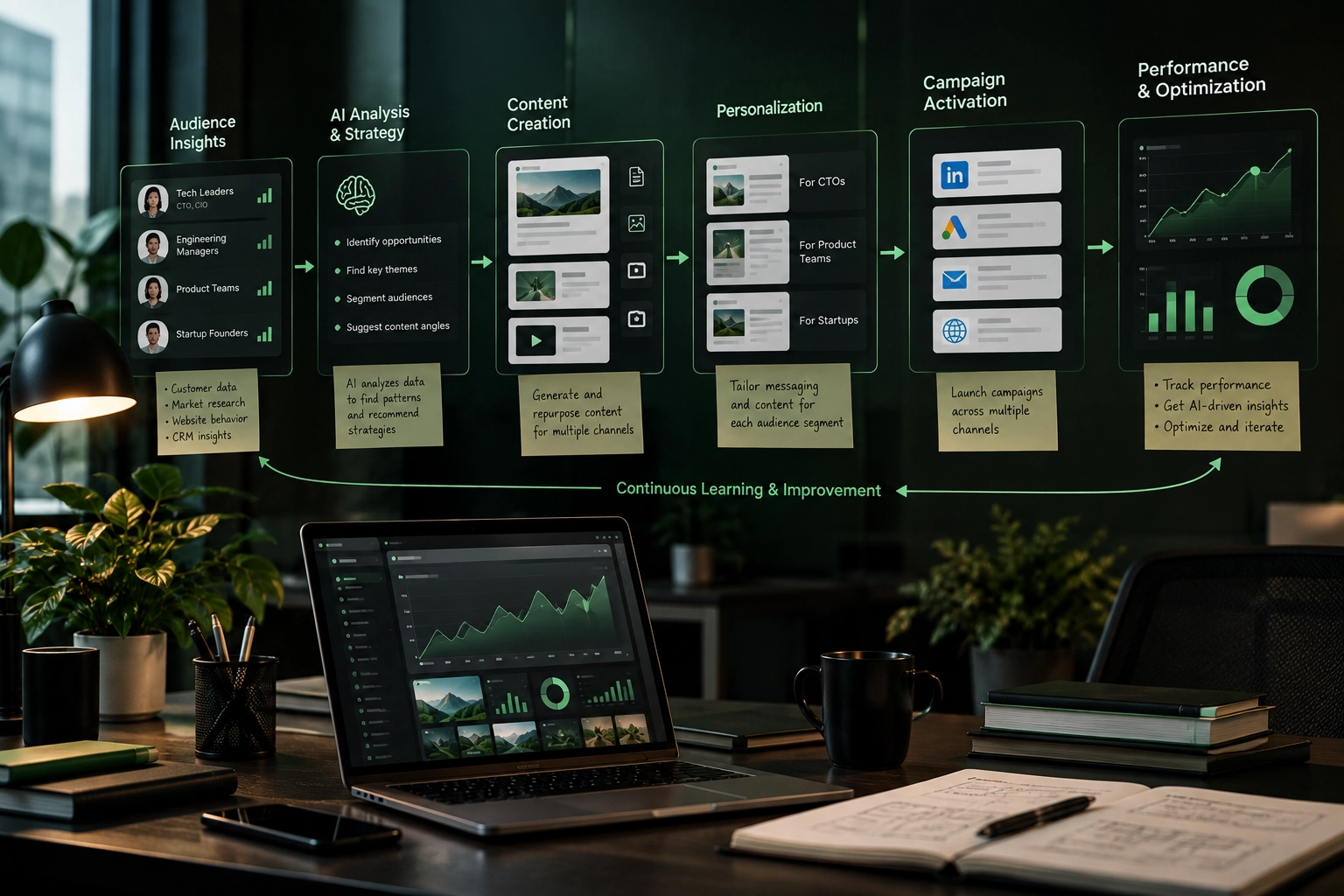
Research → Generate → Personalize → Launch → Analyze → Adapt → Repeat
That difference matters.
AI can reduce the time required to move between these stages, allowing marketing teams to test more ideas, respond to data faster, and personalize experiences at a much larger scale.
The result is not necessarily a world where marketers create less.
Instead, marketing teams can spend less time on repetitive production and more time on strategy, experimentation, positioning, and customer understanding.
1. AI Is Changing How Marketers Understand Their Audiences
Good marketing starts with understanding people.
Technology companies often have access to enormous amounts of customer information, including website interactions, CRM records, product usage, support conversations, campaign performance, sales activity, and customer feedback.
The problem is rarely a complete lack of data.
The problem is turning that data into useful insight.
This is one area where AI in marketing can make a significant difference.
AI systems can help marketers identify patterns across large datasets, summarize customer feedback, segment audiences, detect recurring questions, and highlight behavioral trends that might otherwise take hours of manual analysis.
For example, a technology company could analyze customer support conversations to identify recurring problems.
Those insights could then influence:
- Blog topics
- Landing page messaging
- Product education
- Email campaigns
- Sales enablement content
- Customer onboarding
- Advertising messages
HubSpot’s 2026 research reports that marketers are already using AI for customer research and personalization, showing that AI’s role is expanding beyond content generation into understanding customers and turning those insights into marketing decisions. HubSpot Blog
However, there is an important distinction.
AI can identify patterns.
Marketers still need to decide what those patterns mean.
A dataset can tell you that customers repeatedly mention a particular problem. Strategic judgment determines whether that problem deserves a new article, product improvement, campaign, feature explanation, or completely different positioning.
2. AI Makes Personalization More Practical
Personalization has been a marketing goal for years.
The challenge has always been scale.
Creating a different message for every customer segment manually requires significant time and resources. AI makes it much easier to create and adapt marketing experiences for different audiences.
This is where AI personalization becomes especially useful.
Instead of showing the same message to everyone, a technology company could tailor its communication based on factors such as:
- Industry
- Company size
- Customer stage
- Product interest
- Previous interactions
- Geographic market
- Business needs
- Content engagement
For example, a software development company might communicate differently with a startup founder than with an enterprise CTO.
The underlying service could be the same.
The message does not have to be.
AI can help marketers create variations of landing pages, emails, advertisements, product messaging, and educational content while maintaining consistent brand guidelines.
HubSpot’s 2026 marketing research identifies AI-enabled personalized content as one of the leading marketing trends, while its research also reports that personalized or segmented experiences are associated with increased leads and purchases. HubSpot Blog
The important point is that personalization should not mean simply inserting someone’s name into an email.
Effective personalization considers the message, offer, context, creative, timing, and channel.
3. Generative AI Is Changing Content Production
Content creation is currently one of the most visible applications of AI in marketing.
AI can assist with:
- Blog outlines
- First drafts
- Social media copy
- Email campaigns
- Ad headlines
- Product descriptions
- Landing page copy
- Video scripts
- Images
- Presentation concepts
- Content repurposing
HubSpot’s latest 2026 research reports that 80% of marketers use AI for content creation, making it one of the dominant applications of generative AI in marketing. HubSpot Blog
For technology companies, this can dramatically reduce production time.
A single technical webinar, for example, could become:
Webinar → Blog article → LinkedIn post → Short video → Email → Carousel → Sales enablement content
AI can help accelerate that transformation.
But there is a major catch.
More content does not automatically mean better marketing.
As AI-generated content becomes easier to produce, the internet becomes increasingly crowded with generic articles, repetitive social posts, and content that sounds almost identical.
This creates a new competitive advantage:
Original thinking.
Research, experience, technical expertise, customer stories, strong opinions, proprietary data, real examples, and useful explanations become more valuable precisely because generic content is becoming easier to generate.
HubSpot’s 2026 research reflects this shift, noting that marketers increasingly need a distinctive point of view as AI-generated content becomes widespread. HubSpot Blog
AI can help you produce content.
It cannot automatically give your company something worth saying.\
4. The Real Advantage Is More Experimentation
One of the most powerful effects of AI in marketing is not content generation.
It is experimentation.
Before AI, creating five versions of an advertisement, landing page, email, or campaign could require substantial time from designers, copywriters, marketers, and developers.
AI can reduce the production cost of those variations.
That makes it easier to test:
- Different headlines
- Different calls to action
- Different visuals
- Different audience segments
- Different offers
- Different messaging angles
- Different landing page structures
The marketing process becomes less about trying to predict the perfect campaign before launch and more about creating strong hypotheses, testing them, learning from the results, and improving.
This is a fundamental shift.
AI increases the speed of the marketing feedback loop.
The strongest teams will not necessarily be the teams producing the most AI-generated content.
They may be the teams learning fastest.
Dynamic imports allow applications to load components only when they are actually needed.
However, ssr:false should only be used when a component specifically requires client-only rendering.
It is not a universal performance setting.
5. AI Is Changing Paid Advertising
Paid advertising is another area where AI has already become deeply integrated.
Modern advertising platforms use machine learning to make decisions about bidding, targeting, conversion optimization, and creative performance.
Google Ads, for example, uses AI-powered Smart Bidding to optimize bids for conversions or conversion value at auction time. Its current Smart Bidding strategies include Target CPA, Target ROAS, Maximize Conversions, and Maximize Conversion Value. Google Help
This changes the role of the marketer.
Instead of manually controlling every individual bid, marketers increasingly focus on:
- Defining business objectives
- Providing accurate conversion data
- Developing strong creative assets
- Selecting appropriate audiences
- Establishing useful constraints
- Evaluating performance
AI handles much of the optimization underneath.
But this also means that poor inputs can create poor outcomes.
If conversion tracking is unreliable, the AI is optimizing against unreliable information.
If the campaign objective is wrong, better optimization will not solve the underlying problem.
AI can optimize a system. It cannot decide whether the system is solving the right business problem.
6. AI Is Transforming B2B and Technology Marketing
The impact of AI in technology marketing is particularly significant because B2B buying journeys are often complex.
A potential customer might interact with a technology company through:
Search → Blog → LinkedIn → Case Study → Website → Demo → Sales Conversation → Proposal
Each interaction creates information.
AI can help connect those signals and support marketing teams throughout the journey.
For software companies, SaaS businesses, IT service providers, and technology consultancies, useful applications include:
Audience segmentation
AI can identify meaningful patterns between industries, company sizes, use cases, and customer behavior.
Lead qualification
AI can help sales and marketing teams prioritize leads based on available behavioral and business data.
Account research
Marketing teams can accelerate research into target companies, industries, challenges, and relevant messaging.
Personalized content
A technology company can adapt case studies, landing pages, and campaigns to different industries or customer segments.
Sales enablement
AI can help transform existing product documentation, case studies, research, and customer information into useful sales materials.
Campaign optimization
Marketing teams can analyze performance across channels and identify where campaigns need adjustment.
For technology companies, the biggest opportunity is not simply using AI to create marketing material.
It is using AI to connect customer data, content, campaigns, and business outcomes.
7. AI Is Changing Search and Content Discovery
Search is another major area being transformed by artificial intelligence.
Google now includes AI experiences such as AI Overviews and AI Mode, changing how users discover and consume information.
This does not mean traditional SEO has disappeared.
Google’s own guidance states that existing SEO best practices remain relevant for AI-powered search experiences and continues to emphasize unique, useful content that satisfies users.
For marketers, this means the goal should not be to create content simply because an AI system can generate it.
Instead, technology companies should create content that provides something genuinely useful.
That could include:
- Original research
- First-hand experience
- Technical explanations
- Real examples
- Case studies
- Expert opinions
- Comparisons
- Unique data
- Practical frameworks
AI may help with research, outlining, optimization, and content repurposing.
But the underlying value still needs to come from somewhere.
Search is becoming more conversational, but useful information still wins.
8. AI Is Making Marketing Analytics More Actionable
Marketing analytics has traditionally focused heavily on reporting.
How many visitors arrived?
How many leads were generated?
What was the conversion rate?
Which campaign performed best?
AI can help move marketing teams from simply describing what happened toward investigating why it happened and what should happen next.
For example, an AI-assisted analytics workflow could identify:
- A sudden conversion-rate decline
- A high-performing audience segment
- A campaign with unusually high acquisition costs
- A content topic generating qualified traffic
- A landing page with strong engagement but weak conversions
- A customer segment responding differently to a campaign
This does not eliminate the need for analysts or marketers.
Instead, it reduces the amount of time spent manually searching through information.
The marketer can spend more time interpreting results and deciding what action to take.
That distinction matters.
AI can surface the signal. Humans still need to decide what the signal means for the business.

9. AI Is Automating the Marketing Workflow
The next stage of AI marketing automation goes beyond generating individual pieces of content.
AI can increasingly support connected workflows.
For example:
Customer data → Audience segment → Content variation → Campaign → Performance analysis → Optimization
Instead of requiring a marketer to manually initiate every step, AI-powered systems can assist across multiple stages.
This is where AI agents become increasingly important.
HubSpot’s 2026 research reports that more than 85% of surveyed marketing departments use AI agents, while many teams report increasing their agent usage. HubSpot Blog
This suggests a shift from AI as a simple assistant toward AI as a workflow participant.
The difference is significant.
A chatbot waits for a question.
An AI-powered workflow can potentially monitor information, perform multiple steps, evaluate results, and recommend or execute the next action within defined boundaries.
For marketing teams, this could eventually mean more automated campaign analysis, content distribution, lead research, reporting, and optimization.
However, automation should be introduced carefully.
Not every marketing decision should be delegated to a machine.
10. What AI Still Cannot Replace in Marketing
The growing capabilities of AI can make it tempting to ask whether marketers themselves will eventually become unnecessary.
That is the wrong question.
The more useful question is:
Which parts of marketing become more valuable when production becomes easier?
Several remain deeply human.
Brand judgment
AI can generate many possible messages.
Someone still needs to decide which message represents the brand.
Strategic positioning
AI can analyze competitors and markets.
It does not automatically determine what your company should stand for.
Creativity
AI can generate combinations of existing patterns.
Human marketers still provide taste, direction, context, and intent.
Empathy
Understanding what a customer actually feels, fears, values, or wants requires more than pattern recognition.
Original perspective
When everyone has access to similar AI tools, a company’s point of view becomes an important differentiator.
Trust
Technology buyers need confidence that a company understands their problems and can deliver what it promises.
That trust cannot be automated into existence.
The future of marketing therefore isn’t necessarily humans versus AI.
It is increasingly humans working with AI.
11. The Risks of AI-Driven Marketing
The growth of AI in marketing also introduces new risks.
Generic content
If every company uses AI to generate similar content, differentiation becomes harder.
Brand inconsistency
AI-generated content can drift away from established tone, terminology, or positioning without proper controls.
Inaccurate information
AI systems can produce confident but incorrect information. Technical and business content therefore needs human review.
Privacy concerns
Customer data must be handled responsibly, particularly when AI systems process behavioral or personally identifiable information.
Copyright and intellectual property
Organizations should understand how their AI tools process and generate content and establish appropriate internal policies.
Over-personalization
Personalization becomes uncomfortable when customers feel they are being watched rather than understood.
Automation without strategy
Automating a bad process simply makes the bad process faster.
This is why AI marketing strategies should begin with business objectives rather than technology.
12. How Technology Companies Can Start Using AI in Marketing
Technology companies do not need to transform their entire marketing department overnight.
A better approach is to start with specific, measurable workflows.
Step 1: Identify repetitive work
Look for activities that consume significant time but require relatively little strategic judgment.
Examples include:
- Research summaries
- Content repurposing
- First drafts
- Reporting
- Meeting summaries
- Campaign analysis
- Data classification
Step 2: Choose one workflow
Do not introduce ten AI tools simultaneously.
Choose one process where AI can produce a measurable improvement.
Step 3: Connect AI to real business context
Generic prompts produce generic outputs.
Give AI access to appropriate information about your:
- Audience
- Brand
- Products
- Services
- Customers
- Industry
- Campaign goals
Step 4: Keep human review
AI should support marketing decisions rather than automatically making every important decision.
Establish clear review points for public-facing content, customer communications, strategic decisions, and sensitive information.
Step 5: Measure outcomes
Do not measure AI success only by how much content was produced.
Measure things that matter to the business:
Conversion rate.
Qualified leads.
Customer acquisition cost.
Revenue.
Retention.
Engagement.
Time saved.
Step 6: Scale what works
Once one workflow demonstrates clear value, expand AI into adjacent processes.
This creates a more sustainable path toward AI-powered marketing.
13. The Future of AI in Technology Marketing
The next phase of AI in marketing will likely be less about individual AI tools and more about connected systems.
Marketing platforms are moving toward workflows where AI can help with research, content creation, personalization, campaign execution, measurement, and optimization.
We are also likely to see greater adoption of:
- AI agents
- Predictive personalization
- Automated experimentation
- Real-time campaign optimization
- AI-powered search experiences
- Creative performance analysis
- Automated content adaptation
- Smarter customer segmentation
- Human-AI marketing workflows
But technology will not eliminate the fundamentals of marketing.
Businesses will still need to understand their customers.
They will still need a strong product.
They will still need positioning.
They will still need compelling stories.
And they will still need something meaningful to say.
AI simply changes how quickly marketers can move from an idea to a test, from a result to an insight, and from an insight to the next experiment.
Conclusion
AI is changing marketing from a campaign-driven process into a continuous cycle of learning, testing, and optimization.
For technology companies, the biggest opportunity isn’t simply using AI to create more content. It’s using AI to understand customers better, personalize experiences, automate repetitive work, and make faster, data-driven decisions.
The companies that combine AI capabilities with strong strategy, creativity, and human judgment will be best positioned to compete as marketing continues to evolve.
Looking to Use AI in Your Marketing Strategy?
AI can help technology companies improve everything from content creation and personalization to marketing automation, analytics, and campaign optimization.
At Polygon Technology, we help businesses use modern technology to build smarter digital solutions and turn ideas into scalable products.
Have a marketing challenge you’d like to solve with AI? Let’s talk.
We use cookies to ensure that we give you the best experience on our website. If you continue to use this site we will assume that you are happy with it.AcceptPrivacy policy