
AI in Software Testing: Who Is Accountable When AI Agents Sign Off?
AI in Software Testing: Who Is Accountable When AI Agents Sign Off?
AI coding agents can do far more than generate code. Discover seven practical ways to delegate development tasks, manage context, build reusable workflows, and make AI-assisted software development more reliable.
Software Development
November 24, 2026

Jarin Sultana
Software Engineer III at Polygon Technology, contributing to software engineering and quality-focused development practices. Her writing explores AI-assisted software development, agentic QA, testing accountability, and the importance of human oversight in modern engineering workflows.
AI agents can write code and run tests, but who takes responsibility when both miss the same critical failure?
AI coding agents are changing how software gets built. They can generate code, create test cases, execute workflows, and report results in a fraction of the time a human team might need.
But faster development does not automatically mean safer releases.
When one AI agent writes the code and another AI agent tests it, an important question emerges: Who is accountable when the software fails in production?
The answer matters more than ever as engineering teams bring AI agents into their development and quality assurance workflows.
The Settlement That Paid Twice
Imagine a team building a digital wallet used by thousands of small merchants. Customers pay by scanning a QR code, and the money lands in the merchant’s wallet. When merchants want to transfer that money to their bank accounts, they request a settlement.
The development team receives a ticket:
SET-208: Merchant Settlement to Bank Account
The acceptance criteria are straightforward:
- Merchants can request a settlement from the app by entering an amount and bank account.
- A settlement fee is charged, and the wallet balance must cover both the amount and the fee.
- The request requires approval from two different administrators, following a maker-checker process.
- Once approved, the payout is sent to the bank.
- If the bank confirms the payment, the settlement is marked successful.
- If the bank rejects it, the money is returned to the merchant’s wallet.
- Merchants receive notifications whenever the settlement status changes.
The developer builds the feature with an AI coding assistant, then asks the same assistant to generate tests. It produces around 50 test cases covering balance checks, fees, maker-checker approval, successful bank payments, failed payments, and reversals.
Everything passes.
The team’s QA engineer, already busy with another release, asks an AI testing agent to test the merchant settlement journey end to end on staging. The agent requests settlements, approves them, and forces a rejection to check the reversal process.
All scenarios pass.
With green CI results and the agent’s report attached, the QA engineer approves the pull request. The feature ships.
Three weeks later, the bank’s payout gateway slows down.
A batch of settlements is sent, but the bank does not respond. The transactions remain in a “sent to bank” state. The next morning, the operations team uses an older retry tool from another workflow to push them through.
There is one problem: the bank had already processed the original payments. Its confirmations simply arrived late.
Six merchants receive their money twice. Recovering the funds takes two weeks of difficult conversations.
The Real Failure Happened Before Production
During the post-incident review, the engineering lead asks a simple question:
“At what point did a person decide this was ready to ship?”
The developer explains that both success and failure scenarios were handled, and the tests had passed.
The QA engineer points to the AI agent’s end-to-end testing report.
The reviewer confirms that every acceptance criterion had a corresponding test.
All three statements are true. Yet the feature still failed.
The staging bank simulator always responds immediately with either success or failure. The tests and the AI testing agent only encountered those two outcomes.
But payment systems have another possibility: no response at all.
Nobody tested what would happen if the bank did not reply. The acceptance criteria did not mention it either.
The AI tested every answer the bank could give. Nobody tested the bank not answering.
That missing scenario was not simply a testing mistake. It exposed a weakness in the way the team approached AI-assisted quality assurance.
Why Traditional QA Sign-Off Is Changing
AI agents can now generate code faster than many teams can review it. To keep up, engineering teams are also automating testing and handing more QA tasks to agents.
Each step seems reasonable. Together, however, they can quietly remove the independent perspective that traditionally exists between writing code and approving a release.
A developer approaches a feature thinking, “This should work.”
A tester approaches the same feature thinking, “How could this break?”
That difference matters.
An AI agent asked to test a feature may focus on whether the implementation behaves as expected. It may not challenge whether the requirements cover the right scenarios in the first place.
When the coding and testing tools share the same blind spot, the code and its tests can agree with each other while missing the same risk.
There is another problem. When a human reviewer approves dozens of AI-generated pull requests every day, meaningful review can turn into a routine approval process.
A green test report is useful evidence. It is not proof that every important risk has been considered.
So, Who Owns the Production Incident?
Who is responsible for the six double payments?
There is no single, simple answer.
The developer built the feature and its tests. But the tests came from the same assistant that generated the code, and the missing bank-timeout scenario was never considered.
The reviewer checked that every acceptance criterion had a test. Every listed criterion did. The gap was in the requirement nobody had written.
The QA engineer was assigned to test the feature and approved the pull request based on the agent’s report.
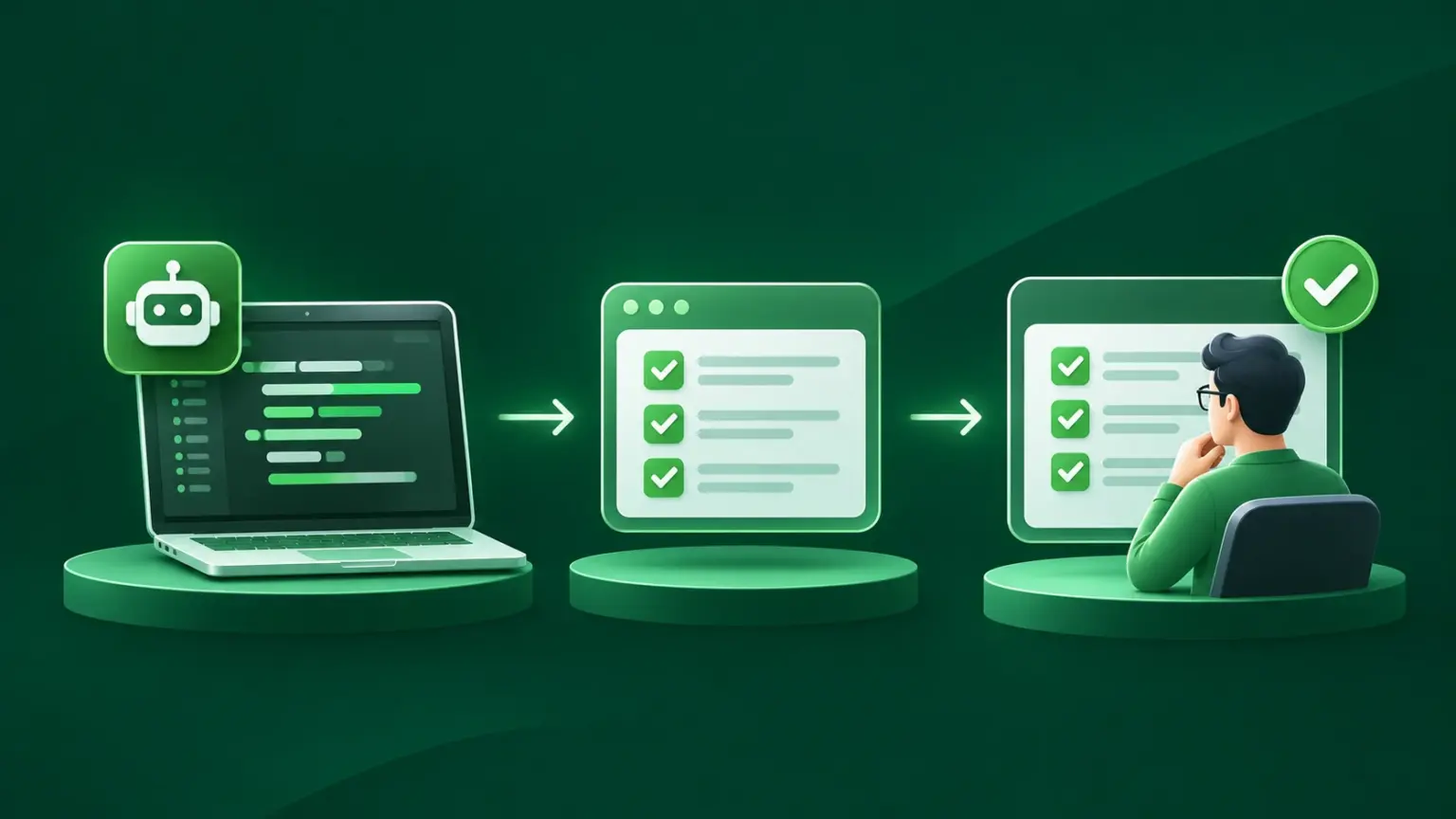
The AI tools contributed to the failure, but they cannot take responsibility for it. They cannot own the production decision or be accountable during the incident review.
The responsibility belongs to the team. However, it is not distributed equally. The developer and QA engineer carry greater responsibility because they were closest to the implementation and its quality approval.
This is not about assigning blame. It is about understanding what ownership means when AI becomes part of the development process.
An AI agent will answer the question you ask it. Sign-off means being responsible for the questions nobody asked.
How to Build Accountability Into AI-Powered QA
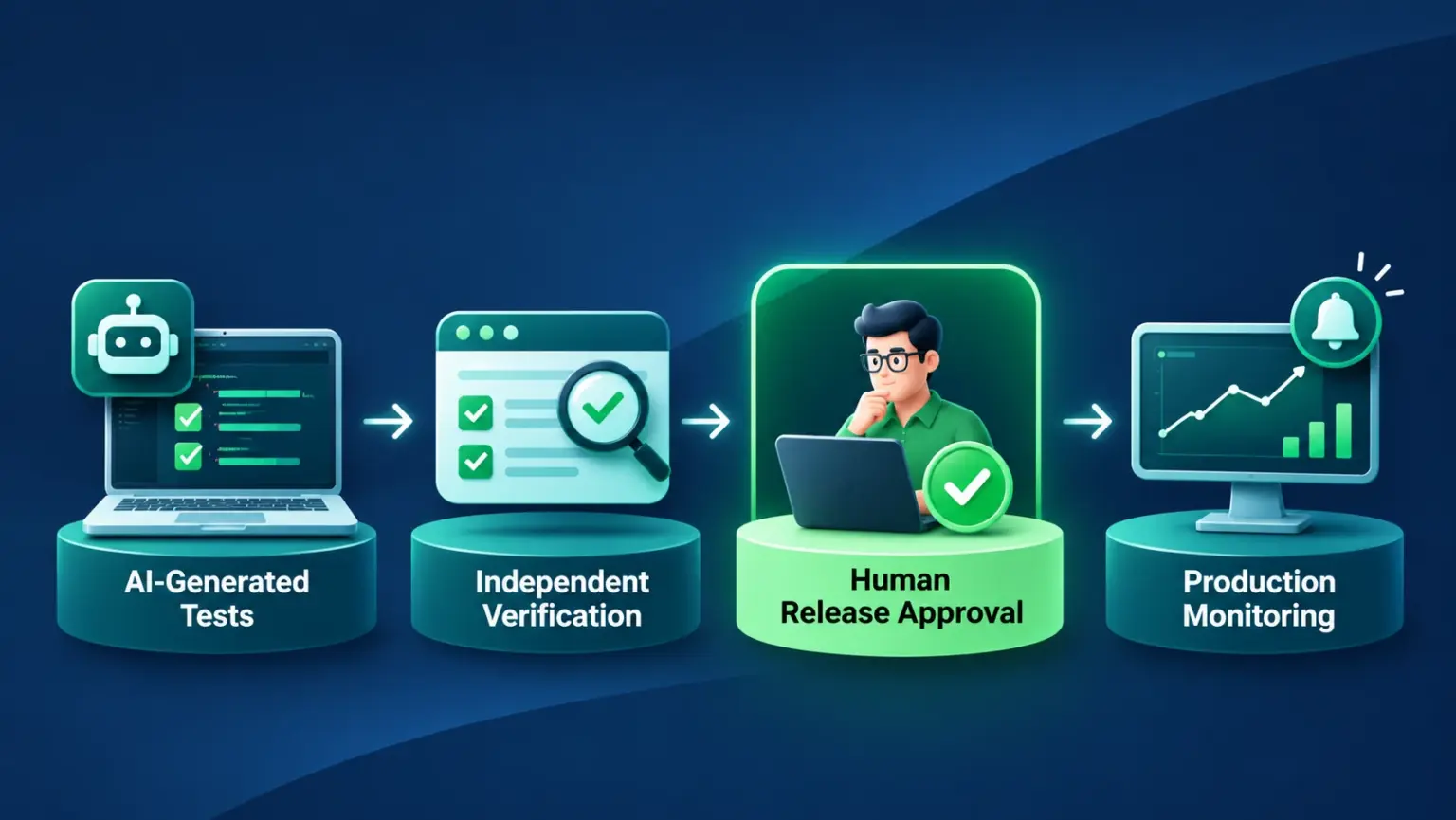
Removing AI agents from the workflow is not the answer. Teams need clearer boundaries around how agents are used and who remains responsible for their decisions.
Here are four practical ways to build that accountability.
- Put a Name on Every Approval Gate
Whenever an AI agent makes a pass-or-fail decision, a specific person should own the rules behind it.
AI can generate test results and highlight potential issues. A human should remain accountable for deciding whether the evidence is sufficient to approve a release.
- Match Human Review to Risk
Not every software change needs the same level of scrutiny. A minor interface adjustment and a financial settlement workflow should not receive identical review.
|
Risk level
|
Example
|
Appropriate review
|
|---|---|---|
|
Low
|
Text or styling changes
|
Automated checks and basic review
|
|
Medium
|
API or business logic changes
|
Independent testing and developer review
|
|
High
|
Payments, authentication, or financial transactions
|
Human-led risk review, independent tests, and release approval
|
The higher the potential impact, the more important independent verification becomes.
- Keep an Audit Trail of Agent Decisions
When an AI agent runs tests, teams should be able to understand what actually happened.
Record the agent and model used, the prompt or task instructions, the tests executed, the tests skipped, and the results.
A report that only says “all tests passed” is not enough to investigate a failure later.
- Don’t Let a Model Grade Its Own Homework
Using the same AI assistant to generate code and validate that code can create correlated blind spots.
For critical workflows, use independent testing approaches. A different model, human-written test cases, and manual review can challenge assumptions that the original coding assistant may have missed.
Production monitoring matters too. In the settlement example, an alert for payouts stuck in “sent to bank” could have helped the operations team identify the issue earlier.
The Tester’s New Job: Owning the Quality Decision
The idea that AI will replace testers often assumes that testing is simply the act of running test cases.
But when an AI agent can execute those tests, someone still needs to decide what “tested” actually means.
The tester’s role is shifting from executing every test manually to owning the quality decision: defining what needs to be tested, identifying what automated agents may have missed, and challenging assumptions before software reaches production.
That requires technical understanding, critical thinking, and the ability to recognize risks that are not obvious from a test report.
AI can make testing faster. It cannot remove the need for someone to understand what the results mean.
Conclusion
AI agents can write code and run tests. They cannot own what happens next.
Before your next release, ask: For every approval gate in the pipeline, whose name is on it?
If the honest answer is “the tool,” your team still has an accountability gap to close.
Explore more insights on AI, software engineering, and quality assurance on the Polygon Technology blog.
We use cookies to ensure that we give you the best experience on our website. If you continue to use this site we will assume that you are happy with it.AcceptPrivacy policy