
Don’t Build an App. Build a Product: A Practical Guide
Don’t Build an App. Build a Product: A Practical Guide
Building an app is only the beginning. Learn how to turn an app into a sustainable product through problem validation, user understanding, monetization, retention, data, distribution, and strategic growth.
Technology
October 5, 2026

Shahadat Hossain
Experienced mobile application developer specializing in Android development and Flutter, with a strong focus on building reliable and user-focused mobile applications. His expertise spans Java, Android development, Flutter, and application design, supported by a solid foundation in software engineering and practical experience in the computer software industry.
Building an app has never been easier.
Today, with modern frameworks, AI tools, cloud services, and endless APIs, almost anyone can build and launch an app.
A solo developer can ship in weeks.
A small team can move even faster.
But here’s the uncomfortable truth:1w
Most apps never become businesses.
Not because they lack features.
Not because the code is bad.
Not because the UI looks outdated.
They fail because they were built like software, not like products.
And that changes everything.
Because an app is technology.
A product is value.
And a business is what happens when that value becomes repeatable, trusted, and scalable.
If you want to build something that lasts, you need to stop thinking like a developer for a moment.
And start thinking like a product builder.
The Difference Between an App and a Product
This is where many builders get stuck.
They confuse shipping with solving.
An app gives users functionality.
A product gives users outcomes.
That difference sounds small.
It isn’t.
When you build with an app mindset, you focus on:
- Features
- UI updates
- Bug fixes
- Releases
That’s software thinking.
But product thinking looks different.
It focuses on:
- User pain
- User behavior
- Retention
- Monetization
- Distribution
- Growth
A simple way to frame it:
App = Tool
Product = Value System
Business = Scalable Outcome
Most people stop at the tool.
That’s why they struggle.
Start With the Problem. Not the Feature.
One of the most common mistakes in product building is starting with excitement instead of pain.
The thinking usually sounds like this:
“What if I build this feature?”
Wrong starting point.
The better question is:
“What problem hurts enough to solve?”
Strong products are built around meaningful problems.
Ask yourself:
- What frustrates people today?
- Where do they waste time?
- What feels inefficient?
- What feels broken?
- Where is trust missing?
The deeper and more widespread the pain, the stronger the potential demand.
Features don’t create businesses. Solving meaningful problems does.
Know Exactly Who You’re Building For
Not everyone is your user.
This is one of the hardest lessons for founders.
The broader your target, the weaker your positioning can become.
You need clarity.
Who are they?
What do they do every day?
What do they struggle with?
What are they using now?
Why would they switch?
Why would they pay?
This clarity shapes everything:
- Your messaging
- Your pricing
- Your feature priorities
- Your retention
- Your growth strategy
Specificity creates momentum.
Generalization creates confusion.
If It Can’t Make Money, It’s Not a Business Yet
A lot of founders delay monetization.
They say:
“We’ll figure that out later.”
That’s risky.
Because monetization affects how you build.
Not just how you sell.
Here are some common models.
Subscription
- Recurring monthly or yearly revenue
- Strong fit for SaaS
- Predictable revenue
- Can support long-term customer relationships
Freemium
- Free entry with paid upgrades
- Useful for reducing barriers to adoption
- Works well when value increases as users engage with the product
Commission
- Earn revenue from each transaction
- Often suitable for marketplaces
- Revenue can scale with user activity
Ads
- Traffic-based income
- Usually requires significant audience volume
- Can be challenging for early-stage products
Lead Generation
- Collect and qualify users, then sell those leads
- Simple to understand
- Can be effective in service-driven markets
The rule is simple:
No monetization path means no clear business path.
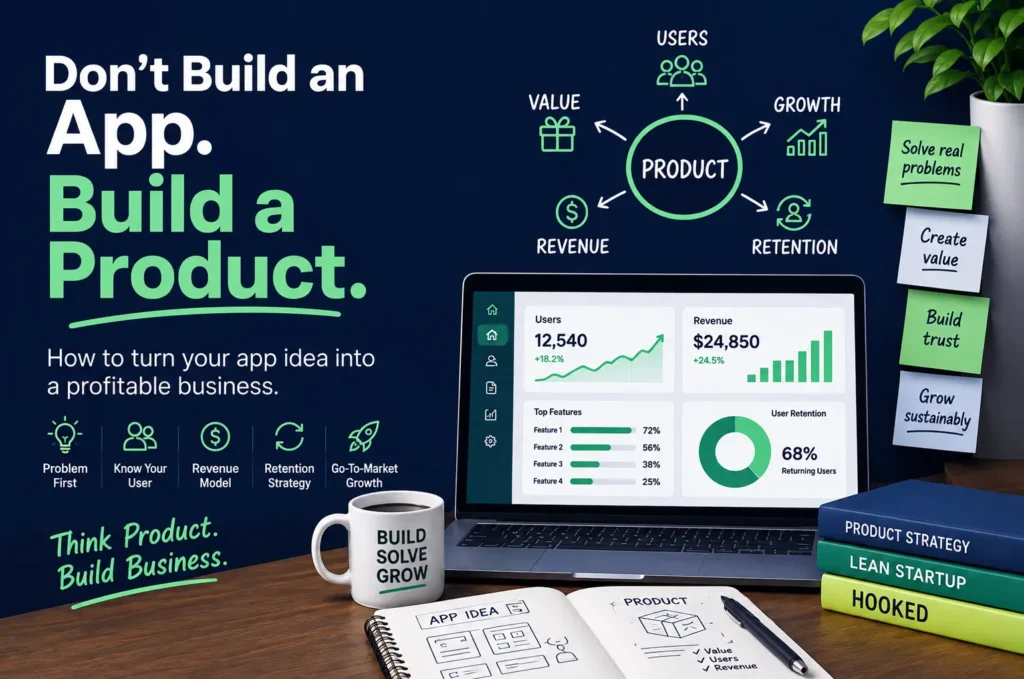
Retention Is the Real Game
Downloads are exciting.
Retention is what matters.
A user installing your app means little if they never come back.
That’s not growth.
That’s curiosity.
Retention is what turns usage into a habit.
And habits create businesses.
Good retention systems can include:
- Notifications
- Personalization
- Saved preferences
- Progress systems
- Watchlists
- Reminders
Ask this question:
“Why would someone open this again tomorrow?”
If the answer is weak, your retention will be weak.
And if retention is weak, your business model will struggle.
Retention Is the Real Game
Downloads are exciting.
Retention is what matters.
A user installing your app means little if they never come back.
That’s not growth.
That’s curiosity.
Retention is what turns usage into a habit.
And habits create businesses.
Good retention systems can include:
- Notifications
- Personalization
- Saved preferences
- Progress systems
- Watchlists
- Reminders
Ask this question:
“Why would someone open this again tomorrow?”
If the answer is weak, your retention will be weak.
And if retention is weak, your business model will struggle.
Maintenance Is More Than Fixing Bugs
This part is often underestimated.
Maintenance isn’t just about keeping servers online.
It’s about keeping the product healthy.
That includes:
- Performance optimization
- Security improvements
- UX refinement
- Crash monitoring
- Infrastructure scaling
- Analytics reviews
- Customer support
- Conversion improvements
A product is never truly “done.”
It’s always evolving.
The moment you stop improving, you start losing relevance.
Think Bigger Than Version 1
The app is rarely the end goal.
It’s usually the starting point.
Great founders understand this.
A single product can expand into:
- Premium services
- APIs
- Enterprise solutions
- Consulting
- Automation layers
- Training systems
- Marketplaces
That’s how ecosystems are built.
Not through endless features.
But through strategic expansion.
Version 1 should open doors, not close them.
The Most Underrated Layer: Go-To-Market (GTM)
This is where many good products struggle.
The assumption is:
Build it. Publish it. Users will come.
They won’t.
Not unless you create a path for them.
That path is GTM.
Go-To-Market is how your product enters the world.
It defines:
- How users discover you
- Why they trust you
- Why they try you
- Why they stay
Product is only half the game.
Distribution is the other half.
Positioning Comes First
Before growth, before ads, before content, you need positioning.
Ask:
- Who is this for?
- What makes it different?
- Why should anyone switch?
Clear positioning makes everything easier.
Weak positioning makes everything more expensive.
Choose Distribution Early
Where are your users already spending time?
That’s where you start.
Possible channels include:
- SEO
- Communities
- YouTube
- Newsletters
- Partnerships
- Referrals
- Founder-led outreach
A great product with weak distribution can still stay invisible.
Your First 100 Users Matter More Than You Think
Your first users are your strongest feedback engine.
They help you:
- Validate the product
- Find friction
- Improve messaging
- Identify missing value
Get them through:
- Beta launches
- Invite-only access
- Community drops
- Direct outreach
- Organic content
The goal isn’t scale.
The goal is learning.
Scale comes later.
Build Feedback Loops Fast
After launch, speed of learning becomes one of your biggest advantages.
Watch for:
- Complaints
- Confusion
- Drop-offs
- Requests
- Churn
The faster you learn, the faster you improve.
And the faster you improve, the faster you can grow.
Simple.
The Product Formula
Most sustainable digital products can be thought of through a simple progression:
Problem → Solution → Trust → Retention → Revenue → Growth → Expansion
Miss one stage, and growth can become fragile.
Strengthen the stages together, and you build a more resilient product.
That’s how real products win.
The lazyOnload strategy delays loading until the browser has completed more important tasks.
However, the best optimization is often removing unnecessary scripts completely.
Regularly review third-party tools and remove anything that does not provide enough value compared to its performance cost.
Final Thought
Building an app is easier than ever.
Building a product is harder than ever.
Because products require more than code.
They require:
Clarity.
Discipline.
Understanding.
Patience.
Conclusion
Before you build your next app, ask yourself:
- What problem am I solving?
- Who exactly is this for?
- Why will they come back?
- How will this make money?
- How will it grow?
Because at the end of the day:
Code builds apps.
Product thinking builds businesses.
Looking to turn an app idea into a product that can grow? Polygon Technology helps businesses turn ideas into scalable digital products through product strategy, design, engineering, and long-term development support.
We use cookies to ensure that we give you the best experience on our website. If you continue to use this site we will assume that you are happy with it.AcceptPrivacy policy